Romania joins with effect of 1 September 2024

A Notice from the European Patent Office dated 5 June 2024 concerning Romania's ratification of the Agreement on a Unified Patent Court and the possibility of requesting a delay in the registration of unitary effect (OJ EPO 2024, A61) indicates that 

"Regulations (EU) No 1257/20121 and (EU) No 1260/2012 establishing the Unitary Patent system have applied since 1 June 2023, the date of entry into force of the Agreement on a Unified Patent Court (UPCA). These regulations implement an enhanced cooperation at European Union level which provides for Unitary Patent protection between the 25 participating EU Member States. Romania is among the EU Member States participating in the enhanced cooperation. Pursuant to Article 18(2) Regulation (EU) No 1257/2012 a European patent has unitary effect only in those participating Member States in which the Unified Patent Court has exclusive jurisdiction with regard to European patents with unitary effect at the date of registration of unitary effect. Consequently, unitary effect will apply to Romania only from the date on which the ratification of the UPCA will take effect in Romania."

"the Government of Romania (RO) deposited its instrument of ratification of the UPCA with the Council of the European Union. The ratification will take effect on the first day of the fourth month after the deposit of the instrument of ratification, i.e. on 1 September 2024 (Article 89(2) UPCA)."

The "first Unitary Patent generation" covered 17 states: Austria, Belgium, Bulgaria, Denmark, Estonia, Finland, France, Germany, Italy, Latvia, Lithuania, Luxembourg, Malta, the Netherlands, Portugal, Slovenia, and Sweden. 

Per 1 September 2024, the Unitary Patent system will comprise the above-mentioned states, as well as Romania, so that it will cover will 18 Member States ("second Unitary Patent generation").

The notice indicates that "The territorial coverage of a given generation of Unitary Patents stays the same for their entire lifetime, irrespective of any subsequent ratifications of the UPCA after the date of registration of unitary effect. Thus, there will be no extension of the territorial coverage of Unitary Patents to other Member States that ratify the UPCA after the registration of unitary effect by the EPO."

The Notice further provides that:

"4. Delay of registration of unitary effect

In order to allow users to benefit from the territorial scope of the second Unitary Patent generation covering Romania, the EPO will accept requests for a delay of the registration of unitary effect as of the date of the present notice. To benefit from the additional service, proprietors will need to expressly request the delay together with their request for unitary effect either in the annotation field of EPO Form 7000 (OLF or OLF2.0) or under separate cover.

If the requirements for the registration of unitary effect as provided for in the Rules relating to Unitary Patent Protection (UPR) are met, the EPO will postpone the registration of unitary effect, i.e. it will register unitary effect on or shortly after the date on which Romania's ratification of the UPCA has taken effect and communicate the date of this registration to the requester. It is reminded that the request for unitary effect must be filed with the EPO no later than one month after publication of the mention of grant of the European patent in the European Patent Bulletin (Rule 6(1) UPR).

The possibility to request a delay of the registration of unitary effect is only available until the date on which Romania's ratification of the UPCA has taken effect."


Germany has ratified: the UPC -and the Unitary patent- kicks off per 1 June 2023!

The website of the Unified Patent Court (UPC) indicates, in a News message dated 17 February 2023, that:

Last week, on 17 February 2023, Germany has ratified the Agreement on a Unified Patent Court.

Germany’s ratification launches the countdown as set under Article 89 of the UPC Agreement according to which the Agreement will enter into force on 1 June 2023.

The Agreement’s entry into force on 1 June 2023 will launch the Unified Patent Court as well as the Unitary Patent (European patent with unitary effect).

Also refer to the news message on the EPO website, "The Unitary Patent is to become a reality".

Adjustment of the timeline: Start of the Sunrise Period on 1 March 2023 – Starting date of transitional measures of EPO remains 1 January 2023

Figure from EPO News message"Unitary Patent: Forms for requesting transitional measures now available" dd 19 December 2022
https://www.epo.org/news-events/news/2022/20221219a.html

The UPC website indicates that the start of the Sunrise Period is postponed for two months. The initial roadmap foresaw 1 January 2023 as the beginning of the Sunrise Period with an entry into force of the UPCA on 1 April 2023. The additional time is intended to allow future users to prepare themselves for the strong authentication which will be required to access the Case Management System (CMS) and to sign documents. As a consequence, the entry into force of the UPCA is now planned to be on 1 June 2023.

In a further message, the starting date of transitional measures of EPO was indicated to remain 1 January 2023. 

Also, Official forms relating to the early uptake of the Unitary Patent are now available on the EPO website.

Entry into force of the UPC Agreement is currently planned for 1 April 2023,

 The latest news message on the UPC website indicates (cited without changes):

Latest state of play in view of the launch of the Unified Patent Court

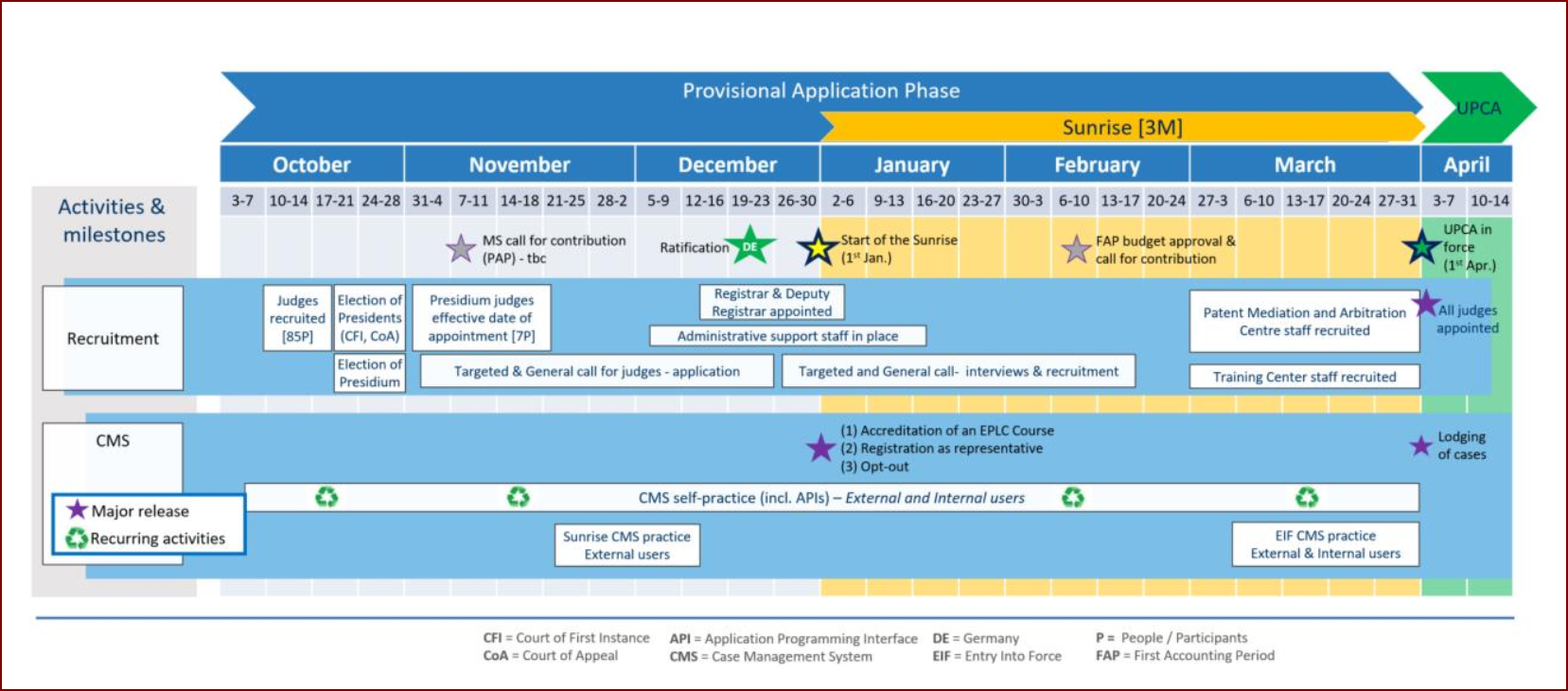
The UPC Preparatory team is excited to share the implementation roadmap attached. This roadmap depicts all the key activities and milestones of the UPC in the coming months.

The entry into force of the UPC Agreement is currently planned for 1 April 2023, with the Court opening its doors and starting to receive cases as from that date.

The UPC Preparatory team is excited to share the implementation roadmap below. This roadmap depicts all the key activities and milestones of the UPC in the coming months.

The entry into force of the UPC Agreement is currently planned for 1 April 2023, with the Court opening its doors and starting to receive cases as from that date.

Please note that this roadmap reflect the current state of the UPC project and therefore, might be subject to change. Any such changes, impacting key deliverables and milestones will be communicated.


The implementation roadmap provides the global milestones:
  • MS call for contribution (PAP)- tbc: call for contribution request to UPC Member States for the Provisional Application Phase (PAP) if needed;
  • Germany ratification: the deposit of the UPCA ratification instrument by Germany will trigger the Sunrise period (first day of the following month) and the entry into force of the UPCA (3 months after the start of the Sunrise period); 
  • Start of the Sunrise: the date of the start of the Sunrise period is expected to be January 1, 2023;
  • FAP budget approval & call for contribution: first accounting period (FAP) budget approval by the Budget Committee and subsequent call for contribution to UPC Member States;
  • [Expected] Entry into force of the UPCA: entry into force of the UPCA and the opening of the Court from 1 April 2023.
Refer to the  implementation roadmap for more details on:
  • Recruitment activities
  • Case Management System activities and milestones


Start of operations of the Court expected in early 2023

According to a News message dated 14 July 2022 on the website of the Unified Patent Court, "the timing of the start of operations of the Court can reasonably be expected to occur in early 2023".

The message is cited in full below (no changes made, except for highlighting):

"The Administrative Committee takes significant steps towards the setting up of the Unified Patent Court

14 July 2022

On 8 July 2022, the Administrative Committee of the Unified Patent Court (UPC) held its second meeting, which took place largely onsite in Luxembourg with the participation of all Contracting Member States and observers. In addition to those observers already admitted in the context of the Administrative Committee’s inaugural meeting on 22 February 2022, a number of observer organisations have now also been admitted pursuant Article 5(7) of the Committee’s Rules of Procedure, namely: epi, EPLAW, EPLIT and BusinessEurope.

As a follow-up to the oral requests of the Contracting Member States during the Administrative Committee’s inaugural meeting, the Committee confirmed the setting-up of local and regional divisions of the Court of First Instance. These divisions will be located in Austria (Vienna), Belgium (Brussels), Demark (Copenhagen), Finland (Helsinki), France (Paris), Germany (Düsseldorf, Hamburg, Mannheim, Munich), Italy (Milan), the Netherlands (The Hague), Slovenia (Ljubljana) and Portugal (Lisbon). The regional Nordic-Baltic division will be mainly located in Sweden (Stockholm). As to the UPC’s Patent Mediation and Arbitration centre, the Committee adopted the Organisational Rules of this Centre, to be set up with seats in Ljubljana and Lisbon.

As to the legal framework of the Court, a major step was taken by the Committee towards ensuring the efficient functioning of the UPC by adopting the Court’s Rules of Procedure and its Table of Fees. Both will enter into force on 1 September 2022. In addition, in the framework of the operational activities of the UPC, the Committee adopted the UPC’s Rules on duty travel, which include incentives for low-carbon emission modes of transport.

From an HR perspective, the Committee also paved the way towards a future recruitment of staff and officials of the Court, by adopting its Medical and social security plan, the Pension scheme and the Internal tax of the UPC.

Last but not least, in accordance with Article 14 of the Agreement on a Unified Patent Court, the Chair of the Advisory Committee presented to the Administrative Committee the recommended list of the most suitable candidates to be appointed as judges of the Unified Patent Court. This list is expected to be adopted any time soon before the summer break, following the conclusion of a written procedure.

Thanks to these key decisions taken by the Administrative Committee on 8 July 2022, the timing of the start of operations of the Court can reasonably be expected to occur in early 2023.

Please note that all non-confidential adopted documents will be made available this week on the Website of the Court [note from the blog editor: they are available here]. As to a consolidated version of the Rules of Procedure, following legal scrubbing, they will be published during the course of the summer, before their entry into force on 1 September 2022."

Also refer to an earlier News message dd 6 April 2022, "The Provisional Application Phase and the UPC’s expected timeline'' and the News message dd 19 January 2022, "Austria closes the loop – the Protocol on Provisional Application of the UPC Agreement has entered into force"

Surprise (?): German government continues its support for the Unitary Patent system

The German government announced that it continues its support for the introduction of the Unitary Patent system in Europe.

On 26 March 202, the German Federal Minister of Justice and Consumer Protection issued the following statement (see here for original):

PRESSEMITTEILUNG | 26. MÄRZ 2020
Europäische Patentreform soll fortgesetzt werden

Das Bundesministerium der Justiz und für Verbraucherschutz hält auch nach der Entscheidung des Bundesverfassungsgerichts vom 20. März 2020 an der Europäischen Patentreform fest.
Mit dem Übereinkommen über ein Einheitliches Patentgericht (EPGÜ) soll ein für alle Vertragsstaaten zuständiges Einheitliches Patentgericht geschaffen werden, das für Rechtstreitigkeiten über europäische Patente nach dem Europäischen Patentübereinkommen sowie dem zukünftigen EU-Einheitspatent zuständig ist.
Die Bundesministerin der Justiz und für Verbraucherschutz Christine Lambrecht erklärte dazu:
„Ich werde mich auch weiterhin dafür einsetzen, dass wir der europäischen innovativen Industrie ein einheitliches europäisches Patent mit einem europäischen Patentgericht zur Verfügung stellen können. Die Bundesregierung wird die Entscheidung des Bundesverfassungsgerichts sorgfältig auswerten und Möglichkeiten prüfen, um den festgestellten Formmangel noch in dieser Legislaturperiode zu beheben.“
Das Bundesverfassungsgericht hat am 20. März 2020 entschieden, dass das Zustimmungsgesetz zum Übereinkommen über ein Einheitliches Patentgericht aus dem Jahr 2013 nicht verfassungsgemäß und daher nichtig ist (Entscheidung im Verfahren 2 BvR 739/17). Damit kann Deutschland das Übereinkommen derzeit nicht ratifizieren. Das Übereinkommen ist bislang von 16 Vertragsstaaten gebilligt worden.
Für das Zustimmungsgesetz wäre nach Auffassung des Bundesverfassungsgerichts eine verfassungsändernde Mehrheit erforderlich gewesen. Die vorgesehene Übertragung von Hoheitsrechten an eine internationale Einrichtung gehe über die vorhandenen Ermächtigungen hinaus. Die Übertragung würde daher ihrem Inhalt nach zu einer Änderung der Verfassung führen. Das angegriffene Zustimmungsgesetz war einstimmig im Bundestag von den in der Sitzung anwesenden Abgeordneten beschlossen worden, jedoch nicht mit der nach Auffassung des Bundesverfassungsgerichts für das Gesetz notwendigen Zweidrittelmehrheit aller Mitglieder des Bundestages.
Das Einheitliche Patentgericht soll künftig in einem einheitlichen Verfahren mit EU-weiter Wirkung über die Verletzung und Gültigkeit von Patenten nach dem Europäischen Patentübereinkommen sowie dem zukünftigen EU-Einheitspatent entscheiden. In Deutschland sollen an den Standorten Düsseldorf, Hamburg, Mannheim und München jeweils erstinstanzliche Kammern des Gerichts eingerichtet werden. Das Berufungsgericht soll seinen Sitz in Luxemburg haben.


The EPO President Campinos reacted to this statement with a news message on the EPO website “Now is the time to make the UPP a reality”, posted on 27 March 2020, reading:

EPO President Campinos: “Now is the time to make the UPP a reality”

27 March 2020
The European Patent Office (EPO) strongly welcomes the announcement of the German government to continue its support for the introduction of the Unitary Patent system in Europe.
In a statement made yesterday on the country's ratification of the Unified Patent Court (UPC) Agreement, German Minister of Justice and Consumer Protection Christine Lambrecht expressed her intention to "carefully evaluate the decision of the Federal Constitutional Court and examine possibilities to remedy the identified lack of form still in the current legislative period."
Commentating on the statement, EPO President António Campinos said, "IP-intensive industries contribute 45% of GDP in the EU annually and 39% of all jobs. But sadly, we know that employment and growth are predicted to suffer badly In the aftermath of the Coronavirus. So it's important that now, more than ever before, measures are taken to support our industries. And we know that the UP and UPC can indeed provide that support, with reduced costs, simplified administration and greater legal certainty.
He added "The statement by the German government makes it clear that approval of the UPC Agreement with the required parliamentary majority is still possible. So it is time to act. It is time to make the long-awaited UPP a reality, for the good of our innovation sector, for the good of our businesses and industries, and for the good of our economy."

Further information


Bundesverfassungsgericht: Act of Approval to the Agreement on a Unified Patent Court is void

The German Bundesverfassungsgericht ruled that the Act of Approval to the Agreement on a Unified Patent Court is void.

The press release can be found here, and is cited in full below with some emphasis added:


Act of Approval to the Agreement on a Unified Patent Court is void

Press Release No. 20/2020 of 20 March 2020
Order of 13 February 2020
2 BvR 739/17
The Act of Approval to the Agreement on a Unified Patent Court (“the Act of Approval”) to confer sovereign powers on the Unified Patent Court is void. In its outcome, it amends the Constitution in substantive terms, though it has not been approved by the Bundestag with the required two-thirds majority. This is what the Second Senate of the Federal Constitutional Court decided on a constitutional complaint in an order published today. In its reasoning, the Senate stated that, in order to safeguard their right to influence the process of European integration by democratic means, this, in principle, also entails the right of citizens that sovereign powers be conferred only in the ways provided for by the Basic Law. An act of approval to an international treaty that has been adopted in violation thereof cannot provide democratic legitimation for the exercise of public authority by the EU or any other international institution supplementary to or otherwise closely tied to the EU.
Facts of the case:
The purpose of the Act of Approval is to establish the preconditions for the ratification of the Agreement on a Unified Patent Court of 19 February 2013 (“the Agreement”). As an international treaty, the Agreement is part of a regulatory package on patents at the core of which lies the introduction of a European patent with unitary effect at EU level by way of enhanced cooperation. The “European patent with unitary effect” provides unitary protection in all participating Member States. The Agreement provides for the establishment of a Unified Patent Court as a court common to most Member States for disputes concerning European patents and European patents with unitary effect. In relation to European patents and European patents with unitary effect, exclusive competence for an extensive catalogue of disputes is to be conferred on the European Patent Court. This catalogue comprises primarily actions for patent infringements, disputes on the validity of patents and certain actions against decisions of the European Patent Office. The draft of the challenged Act of Approval was adopted unanimously by the Bundestag in the third reading but only by about 35 members of the Bundestag present. Neither was the presence of the required quorum determined, nor did the President of the Bundestag declare that the Act of Approval had been adopted by a qualified majority.
Key considerations of the Senate:
I. An act of approval to an international treaty that is supplementary to or otherwise closely tied to the European Union´s integration agenda (Integrationsprogramm) must be measured against Art. 23(1) of the Basic Law (Grundgesetz – GG). Insofar as such an act amends or supplements the Basic Law in substantive terms, or makes such amendments or supplements possible, it requires a two-thirds majority in the legislative bodies pursuant to Art. 23(1) third sentence in conjunction with Art. 79(2) GG. An obligation under international law, assumed in violation of these requirements, that exposes German citizens to the influence of a supranational public authority, violates their right equivalent to a fundamental right derived from Art. 38(1) first sentence and Art. 20(1) and (2) in conjunction with Art. 79(3) GG. In order to safeguard their rights to influence the process of European integration, citizens, in principle, can also claim that sovereign powers be conferred only in the ways provided for by the Basic Law in Art. 23(1) second and third sentence in conjunction with, Art. 79(2) GG (review of the formal aspects of conferral – formelle Übertragungskontrolle). This is because competences conferred on another entity under international law are usually “lost” and cannot easily be regained by the legislator. However, without an effective conferral of sovereign powers, each subsequent measure issued by the EU or a supranational organisation would lack democratic legitimation. Furthermore, the substantive limits to the conferral of sovereign powers that follow from Art. 79(3) GG must always be adhered to.
II. Pursuant to these standards, Art. 1(1) first sentence of the Act of Approval violates the complainant’s right to democratic self-determination derived from Art. 38(1) first sentence, Art. 20(1) and (2) and Art. 79(3) in conjunction with Art. 23(1) third sentence and Art. 79(2) GG, as the Act of Approval was not passed by two thirds of the members of the Bundestag.
1. The Act of Approval confers judicial functions on a supranational court and sets out that this court has exclusive competence to decide on certain legal disputes. Additionally, the Agreement makes decisions and orders of the Unified Patent Court enforceable in any Contracting Member State.
2. The Agreement is supplementary to or otherwise closely tied to the European Union’s integration agenda (Integrationsprogramm) and effectively replaces provisions that did not achieve the majorities necessary to be adopted as EU law.
a) The direct primary law basis of the Agreement is Art. 262 TFEU. It provides for the conferral of jurisdiction on the CJEU in disputes relating to European intellectual property rights, provided there is a unanimous decision of the Council and ratification by the Member States. Until now, the political will has been lacking in this respect.
b) In addition, the Agreement is very closely enmeshed with secondary law enacted on the basis of Art. 118 TFEU. An essential part of the judicial functions of the Unified Patent Court will relate to rights and claims based on EU law the unitary effect of which can only be guaranteed by the provisions laid down in the Agreement. Furthermore, the Unified Patent Court is directly bound by EU law.
c) The Agreement was also pushed forward by EU organs. Since at least the turn of the millennium, the European Commission has insisted on the centralisation of judicial protection in this field. The European Parliament also strongly supported the “European Patent Package”.
The Agreement is open exclusively to EU Member States. The fact that not all EU Member States are also Contracting Member States does not call into question the particularly close ties to the  European Union’s integration agenda (Integrationsprogramm). On the contrary, it is expressly legitimated by the concept of enhanced cooperation and it underlines the close enmeshment with the institutional system of the EU.
3. The Act of Approval is subject to the requirements in Art. 23(1) third sentence in conjunction with Art. 79(2) GG, since it effectively amends the Constitution in substantive terms.
a) The Agreement relates to the Constitution and is a comparable regulation within the meaning of Art. 23(1) third sentence GG given that it contains a provision, which, in its function, is equivalent to an amendment of the Treaties pursuant to Art. 48 TEU. Effectively, the Agreement is an amendment or replacement of Art. 262 TFEU. In Art. 262 TFEU, the Treaty not only calls for a special legislative procedure and a unanimous decision of the Council, but also sets out that provisions conferring jurisdiction shall enter into force only after their approval by the Members States in accordance with their respective constitutional requirements. Thus, Member States considered the creation of novel jurisdiction for the CJEU over industrial property law to be a severe interference with national jurisdiction and designed it as a process requiring ratification. The German legislature classified the process set out in Art. 262 TFEU as a special process of amending the Treaties. By way of the Agreement, the Contracting Members States changed the European Union’s integration agenda (Integrationsprogramm) of the Lisbon Treaty, factually removed the basis of the process provided for in Art. 262 TFEU and rendered a new, EU-inspired type of unified court system for industrial property possible. This is because the necessary unanimity could neither be achieved for the way outlined in the Treaties by Art. 262 TFEU nor for an amendment pursuant to Art. 48 TEU.
b) Regardless of the specific set-up of the patent court system, conferring judicial functions while superseding German courts results in a substantive amendment of the Basic Law within the meaning of Art. 23(1) third sentence GG. Pursuant to Art. 92 GG, judicial power in Germany is exercised by the Federal Constitutional Court, the federal courts and the courts of the Länder. Any conferral of judicial functions on international courts modifies this comprehensive allocation of jurisdiction and, in this respect, constitutes an amendment of the Constitution in substantive terms. The conferral not only affects the fundamental rights guaranteed in the Basic Law, given that German courts can no longer ensure the protection of these rights, but also the specific design of the separation of powers. A significant part of the Member States’ jurisdiction over private and administrative legal matters of economic significance is conferred to the exclusive jurisdiction of the Unified Patent Court by Art. 32 of the Agreement. Under the Agreement, the structure of the German court system set out in the Constitution is modified and supplemented by another court with its own hierarchy.
4. The Act of Approval had to be adopted by a qualified majority pursuant to Art. 79(2) GG. In view of the particular importance of the majority requirement for the integrity of the Constitution and the democratic legitimation of interferences with the constitutional order, a law cannot be enacted when it does not achieve this majority. Thus, the Bundestag did not effectively pass the Act of Approval. It is void. 
Dissenting Opinion of Justices König, Langenfeld and Maidowski
The “right to democracy” does not give rise to a right that formal requirements for the conferral of sovereign powers be adhered to, which can be relied on before the Federal Constitutional Court. This would lead to an extension of the right derived from Art. 38(1) first sentence GG that fails to recognise its substance and limits. There is no scope for a violation of the substance of the right to vote and be elected in a case that only concerns the failure to adhere to formal requirements for an act of approval. This is because this right shall now apparently also be affected in situations in which the Bundestag does indeed seek to establish democratic legitimation for a conferral of sovereign powers, which is permissible in principle, by way of legislation and in which the Bundestag thus performs its responsibility with respect to European integration (Integrationsverantwortung). When the “right to democracy” is extended to cover the adherence to formal requirements for an effective conferral of sovereign powers, it loses its specific substance, which aims to enable and safeguard democratic self-determination. Beyond ultra-vires situations, Art. 38(1) first sentence GG grants such a right only to the extent that an act affects democratic principles that, pursuant to Art. 79(3) GG, are even beyond the reach of the Constitution-amending legislature. Not adhering to the requirement of a majority capable of amending the constitution or other formal requirements when conferring sovereign powers is neither a previously recognised ultra-vires situation nor does it affect those foundations of the principle of democracy that cannot be changed. Consequently, allowing a conferral to be challenged on formal grounds completely blurs the scope of protection of Art. 38(1) first sentence GG in the context of European integration.
Furthermore, a review of the formal aspects of conferral could ultimately – and contrary to the intentions of the Second Senate’s majority – obstruct and narrow the political process in the context of European integration. It can be expected that this further extension of access to the Federal Constitutional Court in almost any case of conferral of jurisdiction within the scope of application of Art.  23(1) GG will prompt the Bundestag and the Bundesrat to seek a two-thirds majority in order to avoid the risk of a review of the formal aspects of conferral. Thus, it will factually become the rule that a two-thirds majority will be necessary not only for conferring additional sovereign powers on the EU, but also for establishing institutions under international law that have close ties to the EU. This is neither the Constitution-amending legislature’s intention nor is it necessary or beneficial for facilitating the democratic process, since decision-making with narrow majorities must also be possible. Granting broad access to the Federal Constitutional Court could prejudice the democratic process in the future and could, if not prevent, at least significantly delay further steps towards integration. The requirement of a two-thirds majority is extended significantly into an area that was previously covered by Art. 24(1) GG. According to this constitutional provision, only ordinary federal law is required for the conferral of sovereign powers. Permitting a review of the formal aspects of conferral opens up further areas to dispute before the Constitutional Court. This will result in the narrowing of Parliament’s necessary political leeway in the context of European integration and the protection of the democratic process intended by Art. 38(1) first sentence GG may thus be turned into its opposite.

United Kingdom ratifies unitary patent


On 26 april 2018 the United Kingdom has ratified the Agreement on a Unified Patent Court. This is one other step towards making the UPC a reality. Ratification of the UK was one of two remaining requirements. The last ratification that is still required is that of Germany. Ratification in Germany awaits the resolution of a court case  that has been pending for about 10 months now before the constitutional court of Germany.

Assuming Germany ratifies before the Brexit is complete, the Agreement on a Unified Patent Court will go into force. One question is what will happen to the position of the UK after it leaves the EU. I'm assuming that the UK considers it likely that they will remain a member; otherwise what is the point of ratifying it. Some legal confirmation of this would be interesting.


Photo by Meditations obtained via Pixabay under CC0 license (no changes made).


EPO publishes unitary patent guide

The EPO has published the "Unitary Patent Guide. Obtaining, maintaining and managing Unitary Patents".  The document tells how to obtain a unitary patent, e.g., how to apply for unitary effect, and what the requirements are. The document also discusses a number of other topics that are relevant for unitary patent proprietors, including the compensation scheme for translations costs and the registering of transfers or licenses.

The document can be downloaded at the EPO. The document looks nice, is well written and seems to be truly useful. Unfortunately,  it will only be really useful once the difficulties surrounding the entry into force have been resolved (see New delay for unitary patent).


Photo by Klimkin from Pixabay under a CC0 license (no changes made).


Is the unitary patent pulled into Brexit negotiations?

Michel Barnier during the 12/07/2017 press conference in Brussels

At a press conference by Michel Barnier, Chief Negotiator for the EU, some comments were made about the unified patent court. On the one hand, he mentions that the location of the unified patent court is not part of his negotiating mandate. On the other hand, he also indicates that the location of UPC is being considered, and that it may have to move as a result of the UK's decision to leave the EU. 

I find it difficult to gauge what this could mean for the UPC's prospects. If it is not formally part of the Bexit negotiation, then this might mean that political agreement is needed at some other level? WIPR has an interesting article about it. 

The press conference can be viewed here at the EU website about the brexit negotiations.  The question leading up to the comments about the unified patent court start at 14:00, Barnier's answer about the Unified patent courts starts at 15:35. The link points to the English translation, but other languages are available.

Photo is taken from the European Commission Audiovisual Services


Battistelli: “nobody knows today” (what will happen to the London court)

Battistelli speaks to award winner Adnane Remmal

At the occasion of the European Inventor Award 2017 (15 June 2017 in Venice), Benoît Battistelli, president of the European Patent Office (EPO) spoke to reporters about the unitary patent (Euractive reports).

According to him the Unified Patent Court is “is not an EU agency”,and so the London location of the court's central division would not have to be relocated to an EU member state after Brexit is complete. Whether that would be politically acceptable  “would be another issue” and “It will depend on the outcome of the negotiations”. He conceded that “nobody knows today” what will happen with the court.

According to the article we do have a new start date though: early 2018.

I'm not sure I'd bet on that. Let's say that early 2018 means March 2018, and assuming an 8-month lead time between ratification and start, this would mean that by August 2017 the UK and Germany have each ratified the UPC agreement.  Given the politically sensitive issue for the UK and the requested delay of the German constitutional court, it seems a bit optimistic that both will be resolved in two months time.


Photo from the Award ceremony photo gallery at EPO. 


New delay for unitary patent


The start of the unitary patent system has a few further setbacks: one less surprising (the United Kingdom), one more surprising (Germany).

Up to now, the goal was to have the system up and running by December this year. That date relied on the timely ratification of the required states. In particular, the United Kingdom ought to have ratified the agreement last May. As that did not happen, the start date of the unitary patent system has also been delayed. The unified patent court has published an update to their timeline, confirming that December 2017 will not be met.

Apart from the ratification of the UK which is not forthcoming, another ratification problem is caused by the Protocol on Provisional Application. This lesser known protocol arranges the starting-up period of the court. Up to now, there are only 11 signatures which is not enough. Interestingly, the United Kingdom has signed the protocol, so no problems there.

The unified patent court has not yet set a new date.

The other setback comes from Germany. According to the Frankfurter Allgemeine Zeitung, the Bundesverfassungsgericht (Germany's constitutional court) has asked the President not to ratify the UPC agreement yet (here is the German article, an English source is here). Someone has brought a constitutional complaint which needs to be settled before ratifying. Kluwer has interesting speculations, that the problem could be more substantial than just the unified patent court. I haven't found confirmation at the website of the Bundesverfassungsgericht yet.

Photo by slon_dot_pics (slon.piccs) via Pixabay under a CC0 license.


New minister for Intellectual Property on Unified patent court


There is a new minister for Intellectual Property in the UK, Jo Johnson. 

The previous minister, Baroness Neville Rolfe, made some promising statements about  the UK's intentions to ratify the agreement on a unified patent court (UPC). She said on the one hand that  the UK government is proceeding with preparations to ratify the Unified Patent Court Agreement, but on the other hand that "(...) the decision to proceed with ratification should not be seen as pre-empting the UK’s objectives or position in the forthcoming negotiations with the EU".

New minister Jo Johnson has confirmed these sentiments and strikes perhaps a slightly more positive note. In a a House of Commons Science and Technology Committee session on 11-Jan-2017, he said "We have taken a decision to proceed with preparations to ratify the UPC Agreement. We believe it is important that we participate in this framework. It has value to UK inventors and businesses and we want to be there at its creation.” He declined to answer how the Brexit might influence this decision though: “These are questions that will form part of the greater discussion of the Brexit negotiations.” (Quotes copied from IP Pro Patents.) 

About a week later, Mr. Johnson submitted an explanatory memorandum to Parliament. The document is an interesting read and stresses the benefits of the unitary patent system. One section to note (section 3.) is the following:

The UPCA establishes a specialised, non-EU patent court under international law with jurisdiction for disputes relating to European patents in 25 European countries. The Agreement is between 25 EU countries (not Spain, Croatia or Poland), the EU is not a signatory, and establishes a court common to the 25 participating countries as an international Organisation with legal personality in each. The UPC is part of the judicial systems of the participating countries in so far as it has jurisdiction over patents valid in their territories. However, the UPC forms a separate jurisdiction to the national court systems and it will not be part of the UK Court system.

This is true, as far as it goes. The unified patent court indeed is not an EU institution. However, it is also the case that the unified patent agreement repeatedly refers to EU law and the EU court of justice. If and how the UK can stay in the UPC after a Brexit is a current debate, and perhaps these are the questions that are part of the greater discussion of the Brexit negotiations that Mr. Johnson ment.

Photo by Myriams-Fotos via Pixabay, under a Creative Commons CC0 license. No changes were made.

UK still proceeding with preparations to ratify Unified Patent Court


In a press release the UK intellectual property office states that they are still proceeding with preparations to ratify the Unified Patent Court Agreement. The press release is optimistically titled "UK signals green light to Unified Patent Court Agreement".

It is not all green lights in the press release though. Baroness Neville Rolfe (Minister for Intellectual Property) links the ratification to access to the free market. Is this press release offering ratification of the unitary patent in exchange for access to the free market? Despite the optimistic language, I still do not expect a quick ratification. If the Article 50 exit negotiations will include negotiating the Unified Patent Court Agreement, it will take at least two more years. Assuming of course, the unitary patent does not fall by the wayside in the process.

Photo "Good to go" by Blondinrikard Fröberg via Flickr under a CC-BY 2.0 license.


EPO ready for unitary patent

Waiting for the UK

According to a statement of the select committee the EPO has completed the legal preparations for the Unitary Patent. In particular, they have approved how the fees coming from the unitary patent are to be distributed among the participating member states.

At present, it doesn't look like many fees will be rolling in any time soon though. When the select committee will have their next meeting will depend on 'the development of the question of the entry into force of the UPP/UPC at the political level, within the framework of the European Union'. As long as the UK does not ratify the Agreement on a unified patent court, the unitary patent cannot start. The UK may or may not do so, but no news is forthcoming from that front. At the latest the select committee will reconvene in March 2017.


Photo by Unsplash via Pixabay, under a CC0 license; no changes were made to the photo.

Labour asks about UK's intentions for unitary patent


The UK Labour party has sent a list of 170 questions to David Davis, the Secretary of State for Exiting the European Union. The list includes two questions on the unitary patent: questions 110 and 111. Also view WIPR's discussion here. 

110. Does the government intend to proceed with ratification of the EU agreement to establish a Unified Patent Court, in the agreement’s present form; and if not, what steps is the government taking to negotiate an alternative agreement to which it would be willing to sign up? 
111. If the Unified Patent Court (UPC) goes ahead, will the Human Necessities seat of its Central Division continue to be located in London, as prescribed in Article 7(2) of the UPC agreement?

The first questions reflects the basic choice the UK now has to make. Does it want to make an effort to stay in the unitary patent, and if not is it worth the trouble to ratify just to leave later on?

If the UK wants to stay in the unitary patent system after Brexit, it seems likely to me that some kind of agreement is needed. If not a new agreement outright  the users will need to see something on paper to restore confidence that their unitary patents will be valid in the UK.

Prime Minister Theresa May has said that she does not want to jeopardize her negotiation strategy. So I  don't expect too much of the answers. Who wants the unitary patent more: the continent or the UK? Could the unitary patent become a bargaining chip?

Photo by geralt via Pixabay under a CC0 license (no changes).

The Netherlands ratify unified patent court agreement


The Netherlands have deposited their instrument of ratification. This makes it the 11th country to do so.

This marks an important milestone since if we add the remaining required countries--the United Kingdom and Germany--we reach 13 ratified countries which is sufficient to start the unitary patent system.

The Dutch government adds that:
Germany is likely to follow shortly. In addition, also approval by the United Kingdom is required. What the exact consequences of the announced 'Brexit' are for when the agreement enters into force, is still unclear.
The latter point is of course the problem. Only if the United Kingdom were to ratify can the agreement enter into force. They are legally fully allowed to do so, but personally I consider it unlikely that they at present will want to take this step.

In all other scenarios, the entry into force will be delayed. Even if the United Kingdom ratifies now, it is unclear what should happen if they leave the EU, but try to stay in the unified patent agreement.

Photo "Tullips in the rain" by Cicely Miller via Flickr under a CC-By 2.0 license (no changes made).

UK Intellectual Property Office makes statement on UPC: no immediate changes


The intellectual property office of the UK has made a brief statement on the unitary patent after the Brexit. According to IPO:
The UK remains a Contracting Member State of the Unified Patent Court at present. We will continue to attend and participate in UPC meetings in that capacity. There will be no immediate changes.
This is the full statement regarding the unitary patent. I can imagine what those UPC meetings will be about, as the unitary patent's future is really murky right now. Different options are on the table, but all of them have downsides. Could the UK live with a UPC agreement that is full of references to EU law? Could the EU live with a UPC member that is not an EU member? There are many more questions than answers.

The statement also mentions other IE rights. If the IE right is not based on EU law, there is no problem (EPC, Madrid system), but what should happen to EU trademarks, and EU designs?


Photo by Couleur via Pixabay under a CC0 license (no changes made).

Battistelli considers unitary patent with UK a 'best case scenario'


Battistelli, the EPO President, discusses two possible scenario's for the future of the unitary patent after the UK voted to leave the EU in the Brexit referendum, in his Blog 'The future of the Unitary Patent package'.

According to Battistelli, "In the best case scenario, the UK could go ahead as soon as possible with the ratification of the UPC Agreement. This would allow the UK afterwards, in its EU exit negotiations, to obtain its continuous participation both in the Unified Patent Court and the Unitary Patent." This option follows the scenario proposed by Hoyng, that we discussed earlier on this Blog. Eplit, the European patent litigator association,  has sent a letter to  Lucy Neville-Rolfe, Minister for Intellectual Property, urging here to take this route and ratify the Agreement.

The advantages are clear, the unitary patent can go ahead as planned, and the UK buys time at least until their formal exit out of the EU on how to proceed. In the meantime a solution can be found that finds a place for the UK in the unitary patent. Either through a creative interpretation of the Agreement on a unified patent court (namely, you should be a EU member to become a participant not not to stay  participant) or in the form of an amendment or side-agreement. The latter options would have my preference, as they give more legal certainty.

In an article at Out-Law, Deborah Bould considers this approach unlikely. "It seems politically unrealistic to suggest that the UK ratifies the UPC Agreement now, to help get the unitary patent system off the ground, and then tries to negotiate to stay in as part of the UK’s exit terms," Bould said. At first glance, it does indeed seems illogical to ratify an agreement that further limits national sovereignty in favor of a pan-European court  just after a brexit vote. On the other hand, a UK in the unitary patent fits nicely in the 'soft brexit' model, in which a close relationship with the rest of the EU is maintained.
 
The alternative considered by Battistelli is to amend the Agreement and continue without the UK. This would give a unitary patent in which the UK is absent, but which still has countries like Germany, France, Italy and the Netherlands, that hopefully will make this 'unitary patent light' sufficiently attractive to be a viable option.

Bould offers yet a further alternative in which the Agreement on a unified patent court is renegotiated and opened up to all EPC member states who are not EU states. I presume Battisteli's option would be easier to obtain, but Bould's suggestion has the advantage that  states like Norway, Switzerland and Turkey could also join the unitary patent. I'm not sure though if it is necessary to codify access to the unitary patent to all EPO states. If the UK can be included in the unitary patent through a kind of extension agreement, then I do not see why a similar agreement can't be made with other EPO member states.
 
In any case, any tampering with the Agreement would take time, and delay the unitary patent, but that is a reality that seems inevitable in any scenario.

Photo by Clker-Free-Vector-Images via Pixabay under a CC0 license (no changes made).